

Last Wednesday morning, I texted Cassie and asked her if I could do a number talk in her classroom. I wanted to see if I could use number talk images to create spontaneous true/false statements out of student thinking. Cassie welcomed me into her classroom.
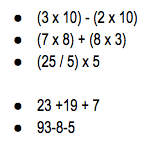
When I got there, Cassie asked me about two of the questions on our benchmark assessment. She had given it to her students and they hadn’t done well on these two questions. She asked me if we could talk about how she might revisit some of the concepts that the questions were supposed to assess. These are the questions:


I have seen this assessment many times. I helped create it. I think these particular questions are actually Smarter Balanced released items. They are supposed to assess 3.OA.5 and 3.OA.6.
While I stood there, in Cassie’s room, waiting for her students to come back from music, I listened to Cassie explain her concerns. She wondered:
- I haven’t presented letters as unknowns. Do third grade students need to use letters to represent unknowns?
- Are my students struggling with the language “the product of 7 and 9”?
I wondered:
- What are these questions actually assessing?
- Are these good assessment questions?
- Does the language have to be so cumbersome?
- Do these question offer an opportunity to engage in the math practices?
- Should we be assessing these standards in isolation?
- How do our benchmark assessments help and/or hinder our instruction?
She asked me if we could adapt my Number Talk to probe her student’s understanding of unknowns, products, expressions, and equivalence? I thought that was a fantastic idea.
Quickly, we brainstormed how we could adapt the lesson. First, we looked at the standards and the assessment and formed a guiding question. We asked ourselves, what do we really want to know about student thinking? This is what we came up with.

Then, we came up with some more specific questions that we hoped would get the students talking.
- What are some math symbols that we use?
- What do the symbols mean?
- What are some words that we are using in math?
- What do the words mean?
We started class by handing out sticky notes and asking students to share their thinking about the following question: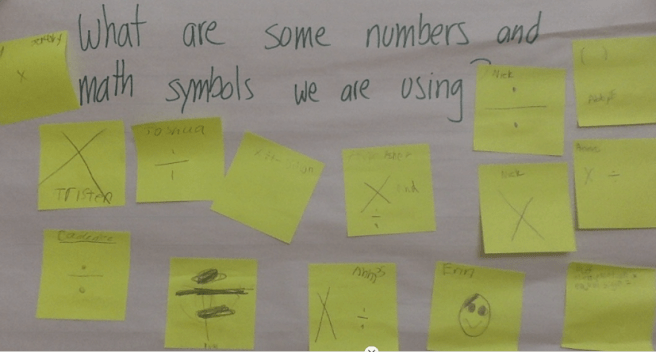
In my quick sweep of the poster, I noticed that no one mentioned any symbols for “unknowns”. I decided I was going to ask about unknowns. I started the conversation by listening for these answers.


I was NOT listening for this answer:

I was going to dismiss the smiley face because it wasn’t the answer I was looking for. Boy was I wrong.
Watch what happened:
When I watch this video, I think I can see myself listening for understanding. It happens when the talking shifts from me to them. They start wondering, debating, conjecturing:
- “You can use anything for an unknown, except for a number.”
- “Actually, you shouldn’t do letters for an unknown.”
- “You can do letters.”
I am listening for understanding, but, in the moment, I don’t know what to do with their thinking. I don’t even know which poster to write it on. All I know is that I should try to follow it and write it down somewhere. I have watched this six minute video clip at least five times. Every time I watch it, I notice something else. Then, I wonder something else. Here are just a few examples:
I decided to tell the students that we would come back to their ideas and questions. I wondered if the students would make connections between their questions about Algebra and our number talk. I wasn’t sure how to answer their questions. When Cassie and I planned the number talk, we tried to anticipate how the students would approach equivalence. We chose to use images of eggs. You can see our plans here. We started with a dozen eggs. When I projected the image, kids just started sharing what they noticed and wondered:
“Why are there shiny ones?”
“Why is there a bigger one?”
“Why is there green and red ones?”
“Those aren’t green. They are brown.”
Then, someone noticed that it was an array. This prompted other students to bring the numbers to the table.

One student said, “Yeah. One plus one equals two. Two by six. You are just using the two since the two is broken up, you are just adding the one and the one for the two.”
When I heard him, I thought he might be trying to explain the distributive property. Was he thinking about two groups of six? I was going to use the opportunity to connect what he was saying to the expression (1 x 6) + (1 x 6), but another student joined in the conversation and it went in a slightly different direction.
When I watch the video, I wonder what would have happened if I had asked the original student to record his own thinking. It is so challenging to record someone else’s thinking. Was I really capturing what he was thinking when I represented the decomposition of 2?
As I listened to the students share their thinking, I was trying to find someone who did not have to compute both sides of the equation. Was there anyone who was seeing that both sides were equal – using the properties – without having to do all the arithmetic? After I listened in on a few conversations, I noticed that Cassie was having a very interesting conversation with two boys. Listen in:
Two by six.
We showed the students another image and discussed their thinking:

Then, we showed them this:
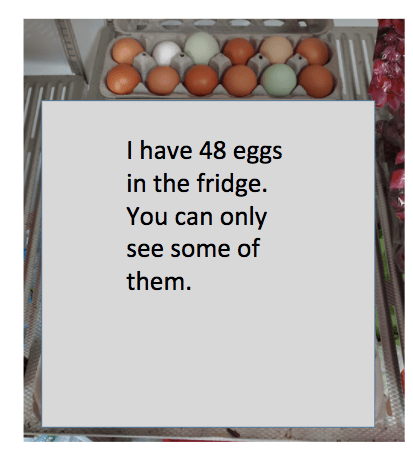
We asked them what they noticed and wondered. Without missing a beat, many of them started talking about how there were probably 3 cartons of eggs under the grey rectangle. We asked them to use numbers, symbols, or words to convince us there were 3 cartons. They did not have a problem with this:


Most students used multiplication to justify their thinking. One student used addition. As a whole, the students seemed to have a pretty good understanding of all the ways you could decompose 48. Most of them were more comfortable with adding partial products (distributive property) than multiplying partial products (associative property). One student tried to use the associative property but I think she lost track of how many times she had actually multiplied 12. She is thinking about “groups of groups”, but her understanding is incomplete. It would be helpful to ask her to find the expressions in her picture. She will probably realize that she has too many groups of 2 x 12.
Finally, we revisited our original question about whether the vocabulary was hindering the students on the assessment. We asked them:
Is 2+2+2+2+2+2 equivalent to the product of 6 and 2?
Many of the students said yes and justified their thinking:


One student changed his thinking:


Several students asked some great questions:


We talked about the definition of product and how it was similar to, but different from the definition of sum. We learned that we needed to revisit what a “difference” is. One of the questions that came up in our discussion of this vocabulary was “Can two statements be equivalent if they have different operations in them?” We explored this question, but I am not convinced that the students have convinced themselves of the answer. How can we explore this more deeply? Why is it important for students to understand that expressions with different symbols can be equivalent? Several students also wondered why this isn’t true:

One student tried to explain why she thought it was true by using smaller numbers and an image. She said, “see. If I have 6 and I divide it into groups of 3, I have two groups. This picture shows both expressions.”
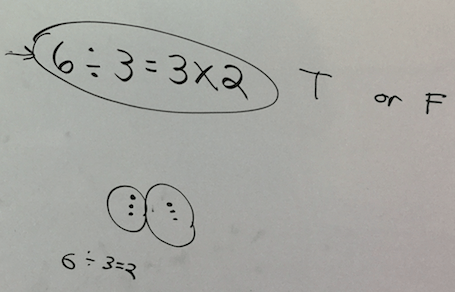
This was a pretty tricky claim to navigate. Cassie and I weren’t sure where to go with it and we would love some advice if you have any. I wish I had done a better job of closing the lesson. I wish I had revisited our guiding question and asked the students to write their thinking in a journal. I think we still have a lot of wonders about Algebra. I think we can dig deeper here. Grab a shovel. Help us out.
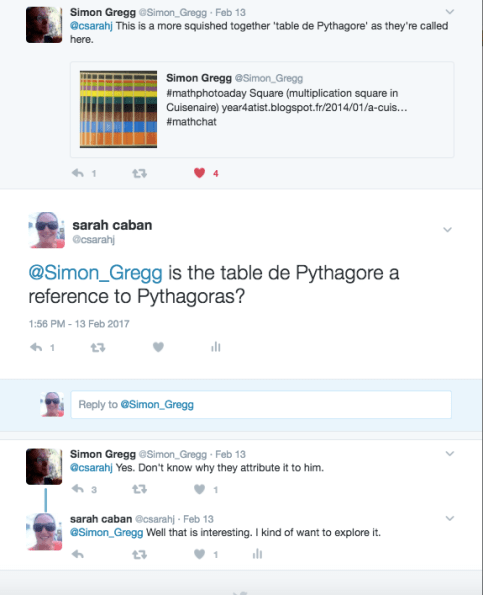

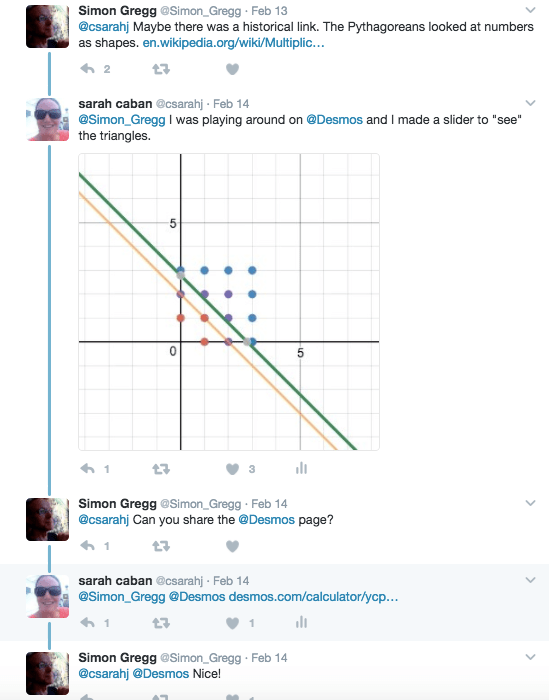
 Here is my response to Simon:
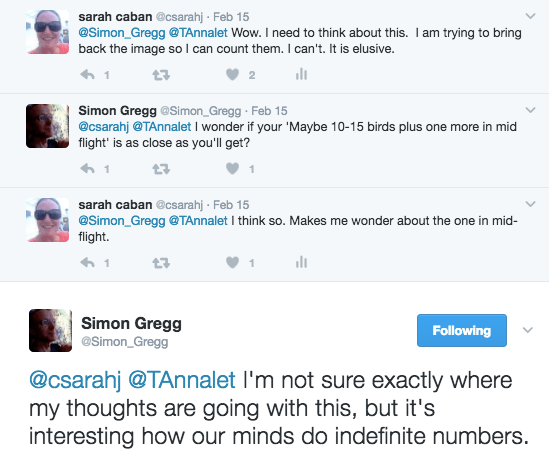
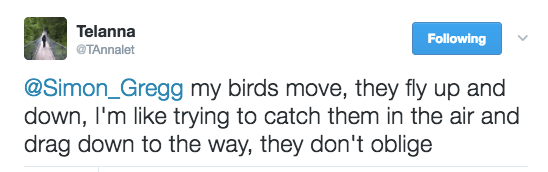 Simon told us that this question was inspired by a quote from Borges: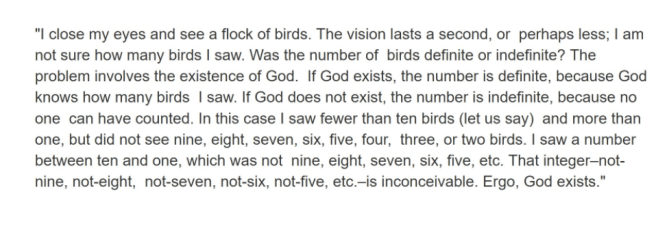










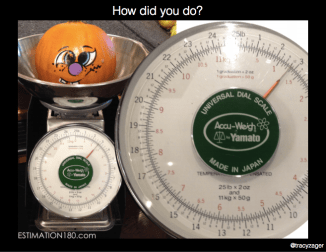


 I followed my intuition both times. When I listened to it, it helped me. Why did I get a closer estimate on the smaller pumpkin?





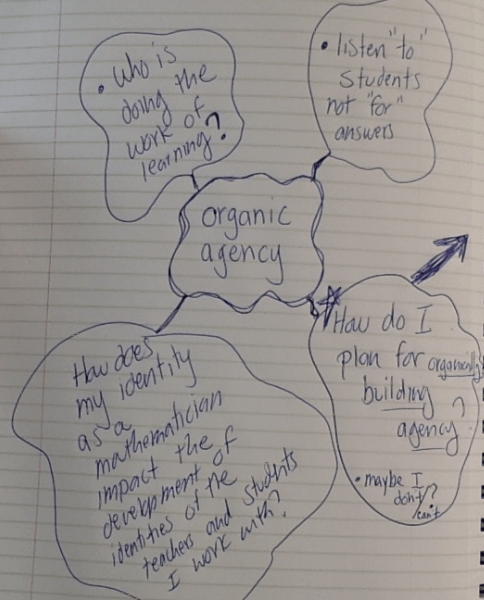


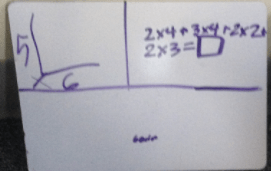

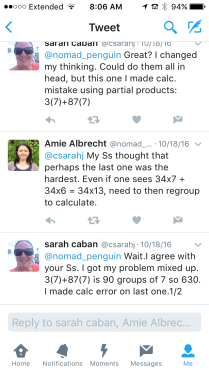
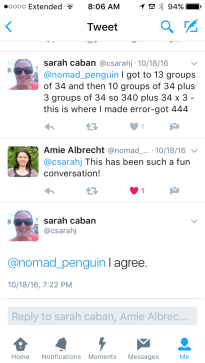
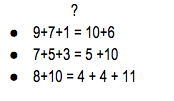
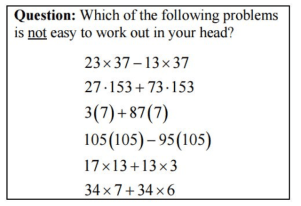 At first, I thought, “how would any of those problems be easy to do in my head?” Then, I saw an entry point. I thought about multiplication as “groups” and I realized that I didn’t actually have to do a lot of complicated computing. I could combine the groups to make friendlier numbers. I thought of 23 x 37 – 13 x 37 as 23 groups of 37 minus 13 groups of 37. That is equal to 10 groups of 37 which is 370. All of a sudden, these problems seemed much more accessible. I was able to solve the others in a similar way, except one. I decided to reach out to @nomad_penguin, who originally posted the problems, to see if she could help me out.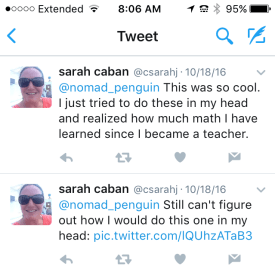


 math on the edge